
Peak Fall Foliage Dates in Gatlinburg: A Year-by-Year Breakdown
Published: September 3, 2026 | Last updated: September 2026 | Update annually each August | Written by: Jess & Michele, The WildNest Collective
Peak fall foliage in Gatlinburg, Tennessee typically arrives during the third week of October — most reliably between October 15 and October 22 — based on historical patterns tracked over the past decade. At Gatlinburg's elevation of 1,289 feet, this is approximately two to three weeks after the high-elevation color peaks above 5,000 feet at Clingmans Dome, and one to two weeks before color reaches the valley floors of Pigeon Forge and Sevierville.
That answer is the reliable baseline. The actual date in any given year shifts by as much as two weeks depending on September weather patterns, rainfall, and summer heat stress. This post breaks down exactly what has happened historically, what drives the variation, and what it means for planning your October trip.
Year-by-Year Peak Color at Gatlinburg's Elevation
The table below documents the estimated peak color window at lower elevations (below 2,000 feet) in and around Gatlinburg for each recent year, based on reports from Smokies Life, the Great Smoky Mountains Association's field reporting program, and the Gatlinburg Fall Colors Forecast records. Peak is defined as the week of maximum simultaneous color across the lower-elevation sugar maple, scarlet oak, sweetgum, and hickory species.
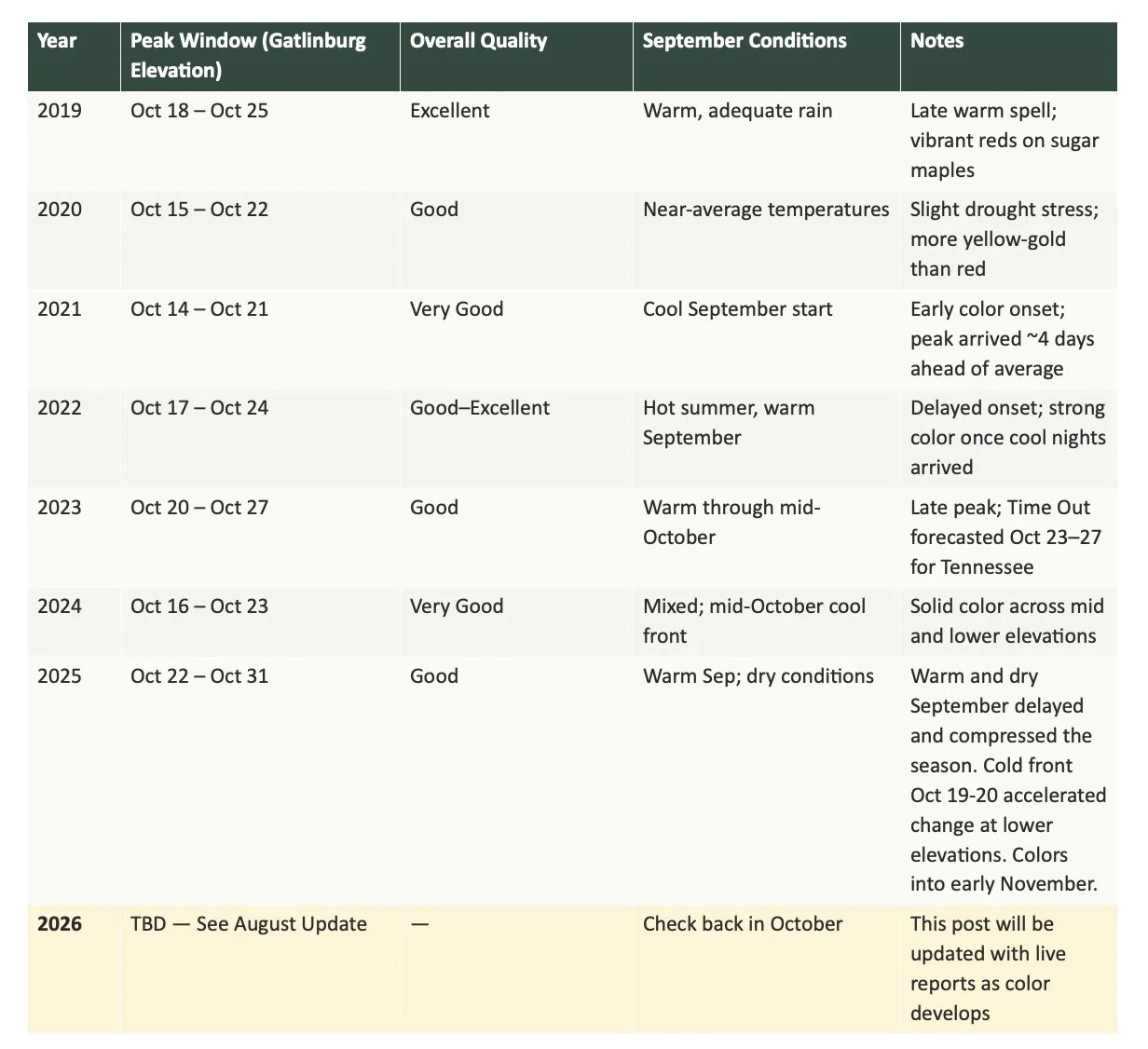
Source note: Year-by-year data compiled from Smokies Life field color reports (smokieslife.org/fall-colors-reports), Gatlinburg TN Guide annual forecasts, and Time Out's national foliage prediction map. Peak windows represent lower-elevation (below 2,000 ft) color only — high-country peaks arrive 2–3 weeks earlier.
The consistent pattern across all years: lower-elevation Gatlinburg peaks in the third week of October in average conditions, with the window shifting toward the fourth week in warm or dry years and toward the second week in cool, early-autumn years. No year in this dataset produced a lower-elevation peak before October 14 or after October 31.
Peak Timing by Elevation: The Complete Picture
Understanding the full picture requires reading fall color across the park's entire elevation range — from the high-country ridgelines at 5,000–6,600 feet down to the valley floors at 876 feet. The Smokies' unusually wide elevation span produces one of the longest fall foliage seasons of any national park in the eastern United States, stretching six to eight weeks from first color to last leaf.
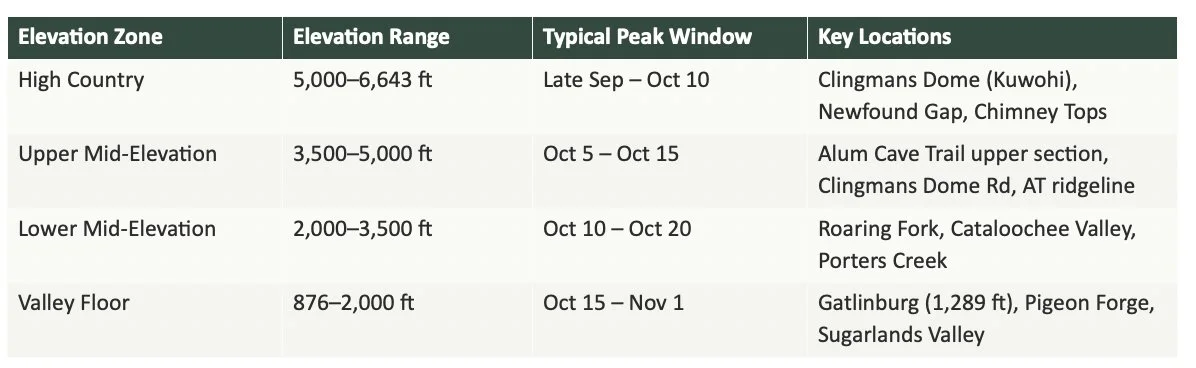
The practical implication of this table: a trip planned for October 8–12 will catch the high-country peak and the beginning of mid-elevation color. A trip planned for October 18–22 will catch the valley-floor peak. A trip planned for October 12–17 has the best chance of catching two zones simultaneously — the mid-elevation colors on the way down from Newfound Gap and the early lower-elevation color beginning to develop in Gatlinburg. The single best week for guests staying at a cabin near Gatlinburg is the third week of October, which aligns with the valley-floor and lower mid-elevation peak in most years.
What Actually Drives Year-to-Year Variation
Two questions drive more October booking decisions than any others: 'Will the color be good this year?' and 'When exactly will it peak?' The honest answer to both requires understanding the variables — and which ones matter most.
September Temperature: The Primary Driver
Leaves begin preparing for color change when days shorten and nights cool below 45°F consistently. September temperature patterns determine when that cooling begins at each elevation. A warm September — like 2023 and 2025 — delays the onset of color across all elevations, pushing the lower-elevation peak into the fourth week of October or early November. A cool September — like 2021 — accelerates the process, bringing peak color to valley floors as early as mid-October.
The relationship is roughly linear: for every degree Fahrenheit above average that September runs at Gatlinburg, expect the lower-elevation peak to shift approximately 1–2 days later. A September that runs 5°F above average can push the Gatlinburg peak from October 18 to October 23–25.
Rainfall and Drought Stress: The Color Quality Variable
Temperature drives timing. Rainfall drives quality. The ideal recipe for peak fall color is adequate summer rainfall followed by dry, sunny October days with cool nights. This combination keeps leaves on the trees while producing the enzymatic reactions that create anthocyanins — the pigments responsible for the reds and purples.
Drought stress, which affected parts of the Southeast in 2020 and 2025, shifts the color palette toward yellow and gold rather than red. Leaves respond to water stress by shutting down earlier and incompletely — producing color that arrives faster and drops sooner. A drought year can compress the peak window from a typical 7–10 days to as few as 4–5 days before leaves begin dropping.
The 2025 season illustrated this clearly: a warm and dry September delayed the start, then a cold front on October 19–20 accelerated color change rapidly, producing a compressed peak with more yellow tones than the vibrant reds of 2019 or 2021.
Freezing Temperatures: The Season-Ender
A hard frost — sustained temperatures below 28°F — is the most reliable way to end a fall color season abruptly. When leaf tissue freezes, cells rupture and the leaf browns and drops within days, regardless of where it was in the color progression. This is why the 'ideal' October forecast calls for cool nights above 32°F rather than freezing ones.
In practice, the Gatlinburg area sees very few hard freezes in October — the valley elevation and regional climate moderate night temperatures even as the high country goes below freezing. But checking the extended forecast in the 10 days before your trip is worthwhile: a cold snap in the October 10–15 window can significantly compress the upper-elevation season before the valley floor peaks.
2026 Forecast: What to Expect This October
Based on summer 2026 temperature and precipitation patterns in the Great Smoky Mountains region, the current baseline forecast places lower-elevation peak color in the Gatlinburg area during the third week of October 2026 — approximately October 15 through 22.
Key factors shaping the 2026 prediction:
Summer 2026 temperatures were near-average across the Smokies region, which does not carry the delay risk of a hot, dry summer
Precipitation has been adequate, reducing drought-stress risk and supporting the conditions that produce stronger reds rather than muted yellows
The critical variable remains September: a warm September will push the lower-elevation peak toward October 22–28; a cooler-than-average September would pull it earlier toward October 13–18
No extended forecasting model can reliably predict the third and fourth weeks of October from August — this prediction will be refined as September data becomes available
This post will be updated with weekly live color reports beginning September 15, 2026. For real-time webcam views of current conditions at Newfound Gap and Clingmans Dome, visit the NPS webcam directory at nps.gov/subjects/air/webcams.htm.
Practical Planning Guide: When to Book Based on the Data
The historical data points to a consistent planning framework, regardless of the year-specific forecast:
If Your Priority Is High-Country Color
Book October 5–12. The high ridgelines above 4,000 feet peak in the first two weeks of October in most years. A trip in this window gives you Clingmans Dome, Newfound Gap Road at high elevation, and the Chimney Tops viewpoints at or near peak. The lower elevations will be in early change — not peak — during this window.
If Your Priority Is Valley-Floor Color
Book October 18–25. This is the most reliable window for lower-elevation color in Gatlinburg across the historical record. Sugar maple, sweetgum, scarlet oak, and hickory at 1,000–2,000 feet are typically at full color during this week. You'll also be able to catch mid-elevation color on drives into the park.
If You Want Both
Book October 12–17. This is the window that most reliably catches both the tail of the high-country peak and the beginning of the valley-floor peak. You'll drive Newfound Gap Road while high elevations are still vivid and return to Gatlinburg as the lower canopy begins to turn. It is also typically one week ahead of the peak October crowd surge, which concentrates on the third and fourth weekends of the month.
When to Book Your Cabin
This question has a simpler answer than the foliage timing: as early as possible. October is the single busiest lodging month in the Smoky Mountains market. According to ShortTermCoops market data cited by regional operators, occupancy in the Gatlinburg area climbs to approximately 77.4% during peak fall foliage weeks. The WildNest Collective's cabins on Braydens Way — The Bluebird and The Finch — typically have their October inventory fully booked before September begins.
Booking timeline: June or July for mid-October dates. August for late October dates. After September 1, October availability at quality properties is limited. If you're reading this in August or September, check availability now — don't wait for the September color reports to confirm dates.
→ The Bluebird and The Finch are available in limited October dates. Every week of delay in booking reduces your options. Check availability now — and if your preferred window is gone, ask about any last-minute openings.
How to Track Live Color Conditions Before Your Trip
For real-time color tracking as your October dates approach, these are the resources that actually work:
Smokies Life Field Color Reports
The Great Smoky Mountains Association publishes weekly field color reports from October 1 through the end of the season at smokieslife.org/fall-colors-reports. These reports are written by naturalists with decades of experience in the park and include elevation-specific observations, tree species breakdowns, and honest assessments of color quality. This is the most accurate and specific color reporting available for the park.
NPS Webcams
The National Park Service maintains webcams at Newfound Gap (grsmnfgap.air-resource.net) and Clingmans Dome (nps.gov/subjects/air/webcams.htm). Both update in near-real-time. The Clingmans Dome camera is particularly useful for tracking the high-country peak in September and early October, since you can watch the color develop from the summit down through the week before your trip.
Fall Colors Report
The official Gatlinburg tourism site posts a weekly fall color timeline at gatlinburg.com/event/autumn-color-in-the-smokies/ with a sliding map showing estimated peak windows across elevations. More general than Smokies Life reports but useful for a quick read on overall conditions.
Interactive Foliage Map
The annual fall foliage prediction map at smokymountains.com/fall-foliage-map uses NOAA historical and forecast data to build an interactive timeline of predicted peak windows across the country. The Tennessee and Smokies-specific prediction is typically posted in August and updated monthly. Use this for early planning; switch to Smokies Life field reports in the final two weeks before your trip for accuracy.
Frequently Asked Questions
When does fall foliage peak in Gatlinburg, Tennessee?
Peak fall foliage in Gatlinburg typically arrives between October 15 and October 22, based on the historical record over the past decade. The exact timing shifts by up to two weeks depending on September temperature and rainfall — warm Septembers delay the peak into late October, while cool Septembers can push it to mid-October.
What elevation peaks first in the Smoky Mountains in fall?
The highest elevations peak first. Above 5,000 feet — at Clingmans Dome and Newfound Gap — color typically peaks between late September and October 10. Mid-elevation zones between 2,000 and 4,000 feet peak from October 10 through October 20. The valley floor in Gatlinburg at 1,289 feet peaks from approximately October 15 through early November.
What year had the best fall foliage in the Smoky Mountains?
Based on field reports and color quality assessments, 2019 and 2021 produced the most vivid lower-elevation color in recent memory. Both years had near-ideal conditions: adequate summer rainfall, a September with a clean cooling trend, and no early frost that would have compressed the season. Both produced strong reds across sugar maple, scarlet oak, and sweetgum species.
How far in advance should I book a cabin for fall foliage in Gatlinburg?
Book as early as possible — ideally four to six months in advance for October. October is the single busiest month in the Smoky Mountains lodging market, with occupancy approaching 77.4% at peak. By September, quality cabin inventory is largely gone. If you're planning an October foliage trip, June and July are the right booking months.
What is the color quality difference between a drought year and a normal year in the Smokies?
In a drought year, leaves show more yellow and gold than red, arrive slightly earlier, and drop faster — compressing the peak window from the typical 7–10 days to as few as 4–5 days. A well-watered year with adequate summer rainfall produces the richest reds in species like sugar maple and scarlet oak, with a longer sustained peak. The 2020 and 2025 seasons were examples of drought-influenced, more muted color; 2019 and 2021 were well-watered years with vivid reds.
Can I predict the exact peak date for fall foliage in the Smoky Mountains?
No. The National Park Service and regional experts agree that exact peak dates are impossible to predict far in advance. The useful approach is to identify a planning window (mid-October for valley-floor color) based on historical patterns, then refine your expectations using live Smokies Life field reports in the two weeks before your visit. The historical record shows a consistent range of October 14–27 for lower-elevation peak color in Gatlinburg — plan for the middle of that range and track conditions as October approaches.
The Bottom Line on Timing
The data is consistent across years: book the third week of October for lower-elevation Gatlinburg color, book the first two weeks of October for high-country peaks, and book the week of October 12–17 if you want the best chance of catching both. Expect the actual peak to shift by up to a week based on September weather, and track live conditions using Smokies Life reports as October approaches.
The one variable that is entirely within your control: booking your cabin early. The foliage timing is uncertain. The certainty that October fills up is not.
→ October availability at The Bluebird and The Finch is limited. If your target window is open, claim it today. If it's gone, reach out — we occasionally have last-minute availability as guests reschedule.